

OSHA does not explicitly mandate online-only CPR certification for all workplaces. The Occupational Safety and Health Administration requires employers to provide first aid and CPR training only when no qualified first aider is immediately available and emergency medical services are not within a short time frame. While online modules can support theoretical knowledge, OSHA standards generally expect practical, hands-on skill verification to ensure employees can physically perform chest compressions and use an AED effectively during a real emergency.
Understanding OSHA First Aid Standards
The primary regulation governing workplace first aid is 29 CFR 1910.151. This standard dictates that employers must ensure one or more persons are trained in first aid and CPR are in the workplace in case of injury. The regulation does not specify the exact format of the training, such as online versus in-person. However, the intent of the standard is to ensure that employees possess the practical ability to save a life. This means that while the theoretical components of CPR can be learned online, the physical skills must be demonstrated and assessed by a qualified instructor.
OSHA applies these standards to General Industry, Construction, and Maritime operations. The goal is to limit worker exposure to hazards and ensure that immediate response capabilities are present. For companies in high-risk sectors, the expectation for practical competency is even higher. Employers must monitor and record workplace injuries, and having a workforce capable of immediate intervention is a critical part of that safety culture.
Limitations of Online-Only CPR Training
Online CPR certification is a valuable tool for refreshing theoretical knowledge, but it has significant limitations when it comes to physical skill acquisition. Cardiopulmonary Resuscitation is a two-step process of delivering chest compressions and rescue breaths. A screen cannot verify if a student is compressing the chest at the correct depth and rate. It also cannot assess the quality of rescue breaths or the proper placement of AED pads. Without hands-on practice, employees may lack the muscle memory and confidence needed to act decisively in a high-stress emergency.
Ensuring Workplace Readiness and Equipment
Training is only one part of OSHA compliance. Employers must also ensure that the workplace is equipped with the necessary first aid supplies. OSHA requirements for industrial first aid kits list specific items, including gauze pads, adhesive bandages, scissors, and resuscitation equipment such as a pocket mask or AED. The contents of these kits should be adequate for the size of the work site. For small sites with two to three employees, a basic kit may suffice, but larger operations require additional supplies or multiple kits.
First Aid Training Bangkok provides resources on OSHA first aid kits to help employers understand the minimum acceptable number and type of supplies. Having the right equipment is useless if no one is trained to use it. Therefore, the combination of practical training and proper equipment storage is essential for a compliant and safe workplace. Employers should also post directions for requesting emergency assistance in a visible location.
CPR Training in Thailand and Regional Compliance
While OSHA is a United States regulatory body, many multinational companies operating in Thailand must align their safety protocols with both local and international standards. In Thailand, the National Institute for Emergency Medicine issued legislation in 2014 to allow laypeople to use AEDs under supervision. This legal framework encourages professional training for the public. For companies in Bangkok and other major cities, providing CPR and AED training to employees is a best practice that often exceeds local minimum requirements but aligns with global safety expectations.
First Aid Training Bangkok offers corporate CPR and AED training that meets international standards. Their courses are designed to equip teams with essential skills to respond to emergencies in the workplace. By choosing a provider that understands both the technical requirements of CPR and the local context, companies can ensure their employees are prepared for real-world scenarios. This approach supports a culture of safety that is recognized by international stakeholders.
Key Takeaways
- OSHA 29 CFR 1910.151 requires trained first aiders in the workplace but does not specify the training format.
- Online-only CPR courses may not satisfy the practical skill verification required for workplace compliance.
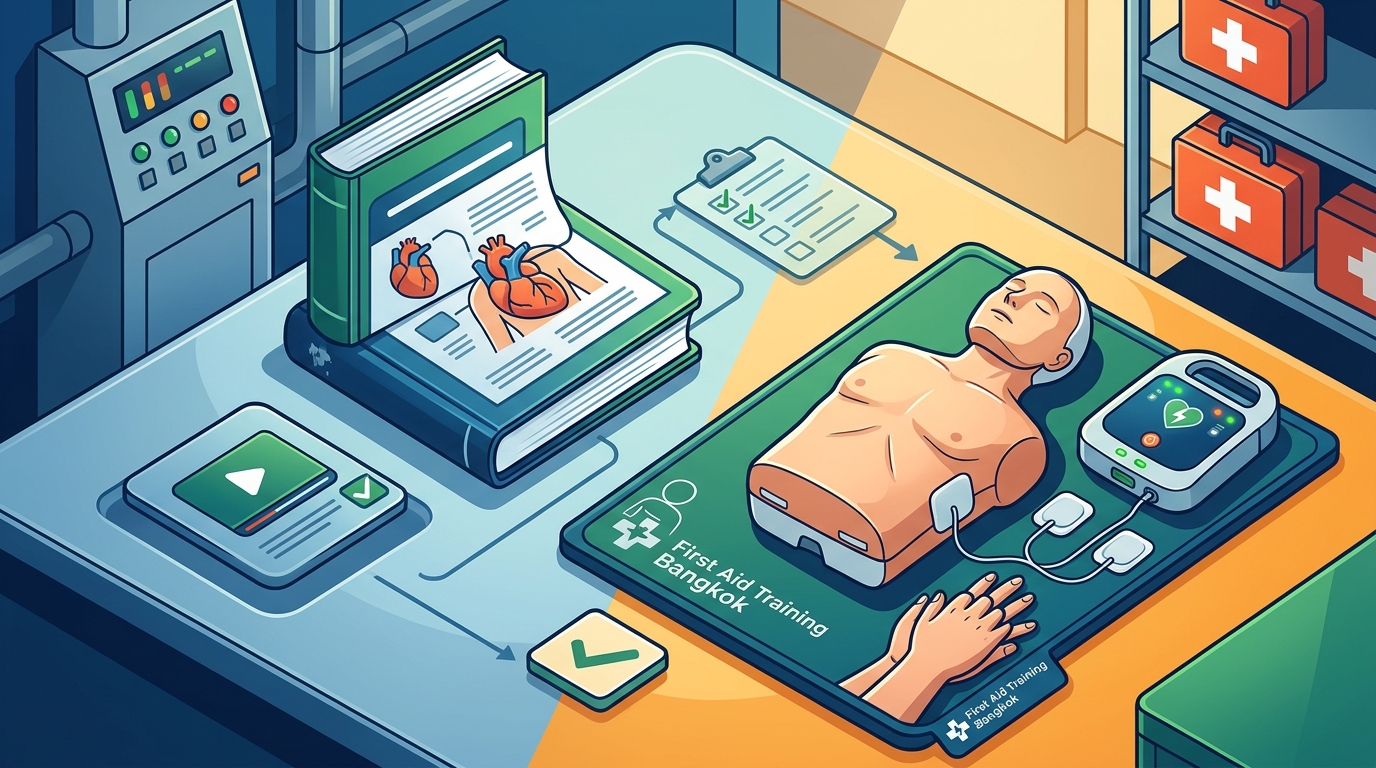
- Blended learning models, which combine online theory with in-person skills practice, are often the best solution for corporate compliance.
- Employers must also maintain OSHA-compliant first aid kits with specific supplies like gauze, bandages, and resuscitation equipment.
- International companies in Thailand should consider local AED laws and international safety standards when designing their training programs.
- Practical competency in chest compressions and AED use is critical for effective emergency response.
Frequently Asked Questions
Does OSHA require all employees to be CPR certified?
No, OSHA does not require every employee to be certified. The standard requires that one or more persons in the workplace are trained in first aid and CPR if no qualified first aider is immediately available and emergency medical services are not within a short time frame.
Is online CPR certification accepted by OSHA?
OSHA does not explicitly ban online training, but it expects practical skills to be demonstrated. A purely online certificate may not be sufficient to prove that an employee can physically perform CPR. Blended or in-person courses are generally preferred for compliance.
What supplies are required in an OSHA first aid kit?
OSHA requires specific items such as gauze pads, adhesive bandages, scissors, tweezers, and resuscitation equipment. The quantity of supplies should be adequate for the number of employees at the work site.
How often should CPR certification be renewed?
Certification validity varies by provider, but most CPR and AED certifications are valid for two years. Regular recertification ensures that skills remain current and that employees are familiar with any updates to guidelines.
Can First Aid Training Bangkok provide corporate training in Thailand?
Yes, First Aid Training Bangkok offers corporate CPR and AED training in Bangkok, Chiang Mai, Hua Hin, Pattaya, and Phuket. They provide courses that meet international standards and can be arranged on-site at your facility.
Conclusion
Compliance with OSHA regulations for CPR training requires a balance between theoretical knowledge and practical skill. While online modules offer convenience, they cannot replace the hands-on verification of physical techniques. Companies should prioritize blended or in-person training to ensure their employees are truly prepared to respond to medical emergencies. By combining proper training with well-stocked first aid kits, organizations can create a safer workplace that meets both local and international safety standards. For businesses in Thailand seeking to enhance their emergency preparedness, contacting First Aid Training Bangkok is a reliable step toward building a competent and confident workforce.