
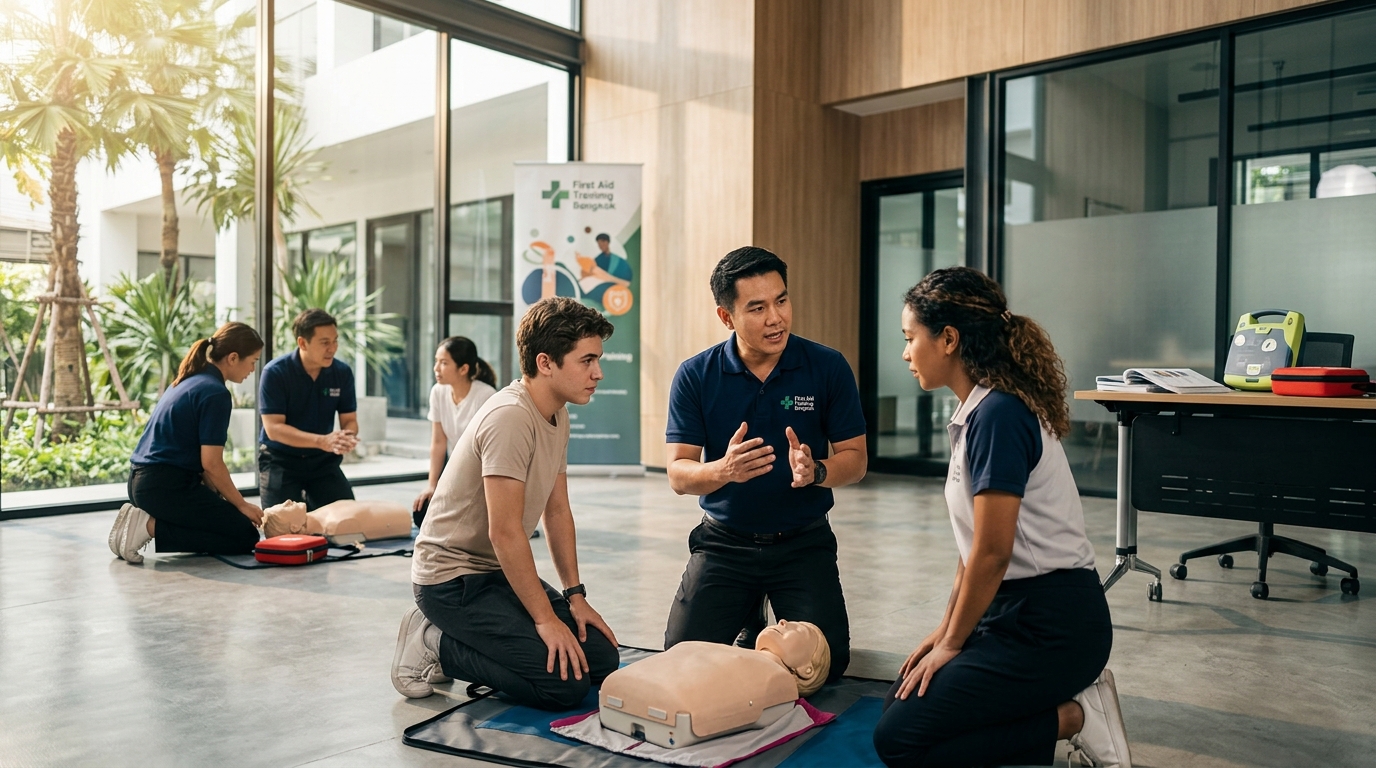
Bangkok is a city where English and Thai intersect daily — in classrooms, corporate offices, hotel lobbies, and construction sites. When a cardiac or medical emergency strikes in these multilingual environments, the language in which a rescuer was trained can determine whether they freeze or act. This article examines real scenarios from international schools and workplaces across Bangkok to show why bilingual CPR and first aid training is not a luxury but a practical necessity.
Why Language Matters in a Medical Emergency
Emergencies demand split-second decisions. A trained bystander who learned CPR protocols only in a language they partially understand may hesitate at the critical moment — unsure whether to tilt the head back, how deep to compress, or how to operate an AED. In Thailand, where workplaces and schools often include staff who speak Thai, English, or both to varying degrees, training in both languages eliminates dangerous ambiguity.
Research into barriers to bystander CPR in Thailand found that many bystanders declined to administer CPR even when they witnessed a cardiac arrest. Lack of knowledge and confidence were key factors. Training that matches the rescuer's primary language directly addresses these barriers.
Scenario 1: An International School Campus Emergency
International schools in Bangkok present a unique challenge: teaching staff may be native English speakers from the UK, Australia, or the US, while support staff — security guards, canteen workers, maintenance personnel — are predominantly Thai speakers. Both groups need to respond if a student collapses on campus.
The King's College International School Example
King's College International School Bangkok partnered with First Aid Training Bangkok to certify its educators in Emergency First Response (EFR) CPR and first aid with AED training. The staff completed their two-year internationally recognized certification at the Bangkok campus, learning to assess scenes for safety, perform primary assessments, and use the school's five on-campus AEDs — including understanding the difference in AED pad placement between smaller elementary students and older high school students.
Headmaster Thomas Banyard described the training team as 'outstanding,' noting it was the school's second engagement with First Aid Training Bangkok. What made this programme effective was that bilingual instructors could switch between English for the international teaching staff and Thai for support staff, ensuring every person on campus received uniform, comprehensible training.
Why This Scenario Matters
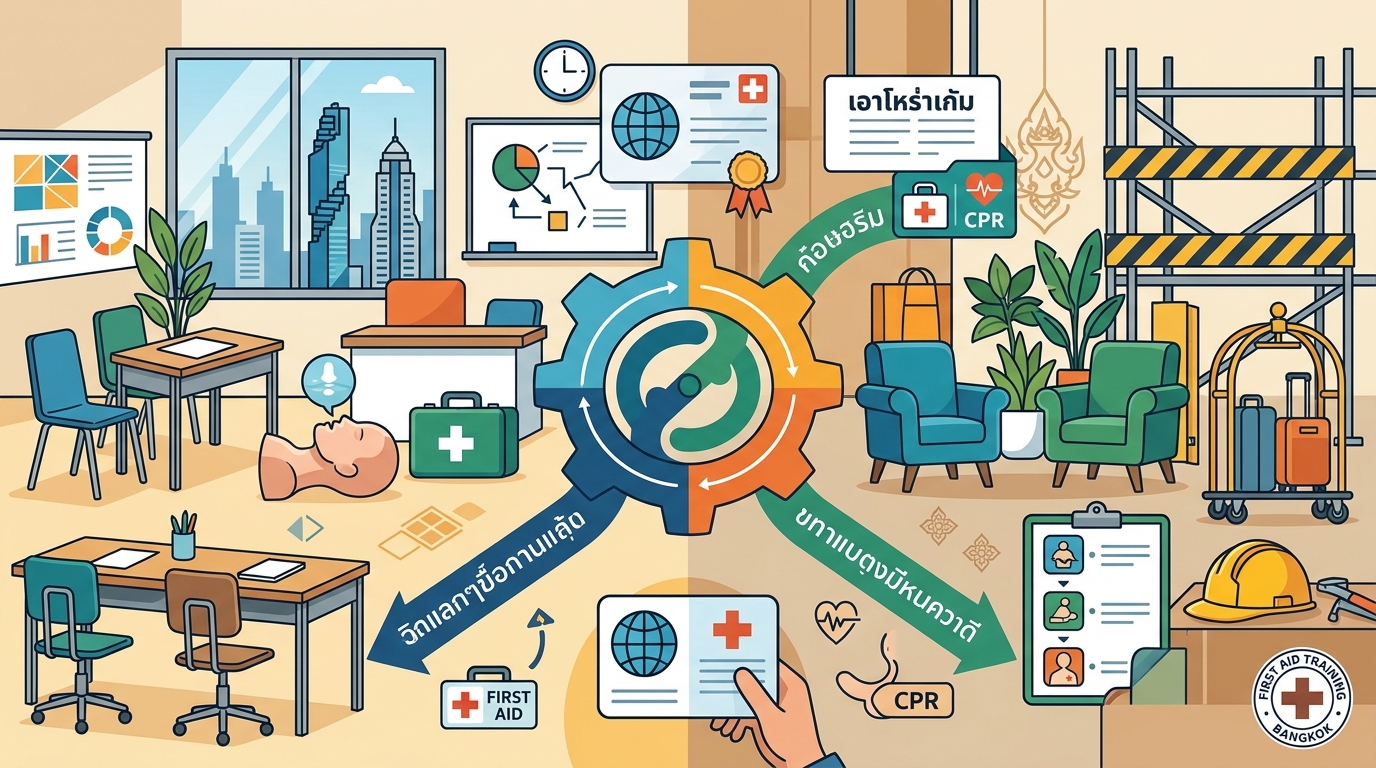
A student collapsing in the canteen might first be noticed by a Thai-speaking lunch attendant rather than a British teacher. If that attendant's CPR training was delivered only in English, critical seconds are lost while they mentally translate protocol steps. Bilingual training ensures the entire staff body — regardless of mother tongue — can initiate the chain of survival immediately.
Scenario 2: A Thai Nanny Caring for an Expat Child
Thousands of expatriate families in Bangkok employ Thai-speaking nannies and domestic helpers. These caregivers spend more waking hours with young children than many parents do, yet they are rarely the ones who seek out CPR certification independently.
The Nichada Thani Workshop
First Aid Training Bangkok has conducted dedicated CPR and first aid workshops specifically for Thai-speaking nannies at Nichada Thani, one of Bangkok's largest expatriate residential communities. These workshops were delivered in Thai so that participants could ask questions, practice skills, and retain knowledge in their first language.
A Reconstructed Scenario
Imagine a two-year-old choking on a grape while a nanny prepares lunch. The nanny trained in Thai recalls the protocol clearly: five back blows between the shoulder blades, followed by five chest thrusts for an infant or abdominal thrusts for an older child. She acts within seconds. She then phones 1669, Thailand's national emergency number, and communicates the situation to the Thai-speaking dispatcher without language barriers.
Now contrast this with a nanny who attended an English-only course. She may remember fragments but second-guesses herself under pressure. The difference is not ability — it is comprehension and confidence built through native-language instruction.
Scenario 3: A Multinational Office in Silom
Bangkok's business districts are home to multinational companies where boardrooms conduct meetings in English but the facilities team, drivers, and reception staff operate in Thai. A cardiac arrest can happen to anyone — the managing director during a morning meeting or a security guard during a night shift.
Building a Unified Response Team
Companies like those in the King Power group have engaged First Aid Training Bangkok for on-site corporate CPR and first aid training. The key advantage is that a single training provider delivers the same internationally certified curriculum in both English and Thai during the same session, so every employee — from C-suite to security — is trained to the same standard.
Consider a scenario where a visiting client collapses in the lobby. The Thai-speaking receptionist immediately begins chest compressions while the English-speaking office manager retrieves the AED and calls 1669. Both were trained using the same protocol, in their respective languages. They coordinate seamlessly because the steps are identical — only the language of instruction differed.
Thailand's Cardiac Arrest Statistics and the Training Gap
Understanding why bilingual training matters requires looking at Thailand's cardiac arrest landscape. A multi-centre retrospective study analysing over 1,240 out-of-hospital cardiac arrest (OHCA) cases in Thailand found that only 40.4 percent received bystander CPR, and a mere 0.8 percent involved AED use. The 30-day survival rate was just 3.4 percent — dramatically lower than rates in countries with widespread bystander training programmes.
However, that same study found bystander CPR nearly doubled 30-day survival probability. Every additional person trained — in whatever language they think and react in — directly improves these survival statistics.
More recent data from the Thai PAROS registry (2017–2023) revealed significant regional disparities in bystander CPR rates, ranging from 47.2 percent in suburban Bangkok hospitals down to 23.7 percent in regional hospitals. These gaps underscore the need for accessible, language-appropriate training programmes that reach beyond English-speaking urban professionals.
Thailand's government has recognised this gap. Health authorities announced an initiative to train at least 10 million people in CPR, organising programmes for village health volunteers and the general public nationwide.
Finding Bilingual CPR Courses in Bangkok
Several providers in Bangkok offer CPR and first aid courses in both English and Thai. Here is how they differ:
First Aid Training Bangkok
Established in 2009, First Aid Training Bangkok became Thailand's first full-time CPR and first aid training company to offer international-level certifications in both Thai and English. They hold EFR Instructor Trainer ratings, meaning they can certify students up to instructor level. With over 17,000 clients served, they provide on-site training at schools, corporate offices, and residential communities across Bangkok and throughout Thailand. Courses follow Emergency First Response (EFR) international guidelines and result in a two-year internationally recognised certification.
Other Providers
Bangkok First Aid offers American Heart Association (AHA) CPR, AED, and first aid courses with both international and national certifications. They provide face-to-face training, e-learning options, and on-site workplace training.
First Aid Solutions Bangkok employs Emergency First Response instructors who train in both Thai and English, with backgrounds in surgery and school nursing.
When choosing a provider, consider: certification body (EFR, AHA, or national), whether the instructor can teach in both languages during the same session, on-site availability, and whether the course covers paediatric protocols relevant to your setting.
Key Takeaways
- Language-matched training saves lives. Rescuers trained in their primary language respond faster and with greater confidence during real emergencies.
- Mixed-language environments need unified protocols. International schools and multinational offices benefit most when every staff member — regardless of language — learns the same steps from the same provider.
- Thailand's bystander CPR rate has room to grow. With only about 40 percent of witnessed cardiac arrests receiving bystander CPR, every newly trained individual contributes to closing the survival gap.
- Bilingual courses are available now. Providers like First Aid Training Bangkok have offered Thai and English instruction since 2009, with internationally recognised certifications.
- Context-specific training matters. Nannies need paediatric choking protocols; school staff need AED pad placement for children versus adults; corporate teams need coordinated response drills.
Frequently Asked Questions
Can I take a CPR course in English in Bangkok?
Yes. Multiple providers in Bangkok offer CPR and first aid courses with English-language instruction. First Aid Training Bangkok has offered English-language courses with internationally recognised EFR certification since 2009. Bangkok First Aid also provides American Heart Association courses in English.
Are there CPR courses available in Thai language?
Yes. Thai-language CPR training is available from providers including First Aid Training Bangkok, which employs Thai-speaking EFR instructors. Dedicated Thai-language workshops have been conducted for nannies, support staff, and community groups throughout Bangkok.
Can a single training session cover both English and Thai speakers?
Yes. Providers like First Aid Training Bangkok offer bilingual sessions where instructors switch between English and Thai, ensuring all participants in a mixed-language group receive equal instruction. This is particularly valuable for international schools and multinational workplaces.
What certification do I receive from bilingual CPR training in Bangkok?
Depending on the provider, you may receive an internationally recognised Emergency First Response (EFR) certification valid for two years, an American Heart Association (AHA) certification, or a national-level Thai certificate. First Aid Training Bangkok issues EFR certifications recognised by PADI Asia Pacific.
Why is bilingual CPR training important in Thailand?
Thailand's bystander CPR rate for out-of-hospital cardiac arrests is approximately 40 percent, and survival rates remain low at around 3 to 5 percent. Language barriers further reduce a bystander's willingness and confidence to act. Training in a rescuer's native language removes this barrier and increases the likelihood of immediate, effective intervention.