
Essential Standards and Recognition Criteria for One-Day CPR Certification in Bangkok
Emergency response capabilities have become a critical component of workplace safety and personal preparedness in Southeast Asia. According to recent public health data, immediate intervention during cardiac arrest can double or triple a victim's chance of survival. This statistic underscores why one-day CPR certification in Bangkok is no longer just an optional skill but a mandatory requirement for many corporate and educational sectors. The demand for reliable, internationally recognized training has surged, making it essential to understand the rigorous standards that validate these courses. (About Us First Aid)
Understanding International CPR Standards
When seeking CPR certification in Bangkok, the primary concern is always the validity of the credential. Not all certificates are created equal. The most reputable courses adhere strictly to the latest guidelines established by global health organizations. These guidelines dictate the specific techniques for chest compressions, rescue breaths, and the use of Automated External Defibrillators (AEDs). (First Aid training and)
CPR is a standardized method of emergency care used to manually preserve intact brain function until further measures are taken to restore spontaneous blood circulation and breathing in a person who is in cardiac arrest. The effectiveness of this technique relies entirely on the precision of the performer. In Thailand, the leading training providers align their curricula with the American Heart Association (AHA) and the European Resuscitation Council (ERC) protocols. This alignment ensures that the skills learned are universally applicable and medically accurate.
For professionals in the diving industry, the standards are even more specialized. Emergency First Response (EFR) is a brand of emergency care training programs developed by PADI. It is designed to help rescuers prevent and minimize the consequences of injuries and illnesses. The EFR curriculum is widely recognized in the Asia Pacific region as the gold standard for dive-related emergency care. Choosing a provider that is an official EFR center guarantees that the training meets these high-level international benchmarks.
Recognition Criteria and Accreditation
Recognition is the cornerstone of a valid certification. A certificate is only as valuable as the organization that issues it. In Bangkok, the most trusted providers are those that have achieved specific accreditations from global bodies. One of the most significant distinctions is being an authorized EFR Center. This status is not granted lightly; it requires rigorous auditing of instructor qualifications, curriculum fidelity, and equipment standards.
First Aid Training Bangkok stands out as the only EFR Center in the region to be internationally recognized and awarded by EFR/PADI Asia Pacific. This award acknowledges their outstanding contribution to first aid training. This recognition is crucial for individuals who work in tourism, hospitality, or diving, where international compliance is often a contractual requirement.
Another critical criterion is the presence of a Medical Advisory Board. Leading training organizations do not operate in a vacuum. They employ a team of medical professionals, including doctors and critical care nurses, to review and update their protocols regularly. This ensures that the training reflects the most current medical science. For example, the integration of tactical combat casualty care (TCCC) principles into civilian training is a recent advancement that requires specialized medical oversight.
Furthermore, the legal standing of the certificate in Thailand is important. While CPR is a universal skill, the legal protections for Good Samaritans vary by jurisdiction. Understanding the local laws is part of a comprehensive safety education. Providers that offer insights into the Good Samaritan Laws in Thailand add significant value to their courses, helping students understand their rights and responsibilities when intervening in an emergency.
The Structure of a One-Day Course
A one-day CPR certification course is intensive by design. It must cover a vast amount of material in a short timeframe. The structure typically follows a blended learning model or a fully immersive hands-on approach. The goal is to build muscle memory and confidence in high-stress scenarios.
The course usually begins with a theoretical overview of emergency response. This includes recognizing the signs of cardiac arrest, choking, and other life-threatening conditions. The theory component is often delivered through online eLearning modules, which allows students to learn the concepts at their own pace before attending the practical session. This hybrid approach maximizes the time spent on hands-on practice.
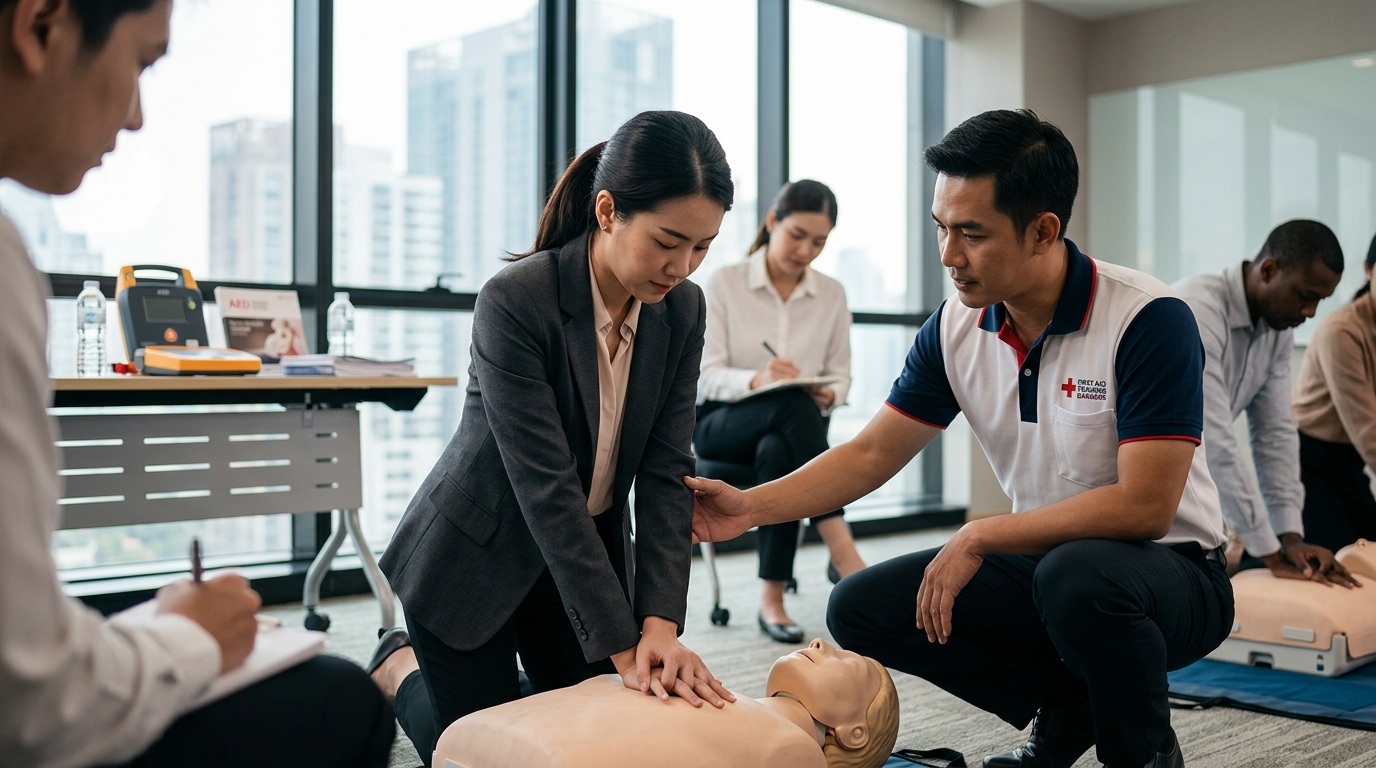
The practical portion is the core of the certification. Students practice chest compressions on manikins, perform rescue breaths, and learn to operate an AED. The ratio of students to instructors is critical. A low student-to-instructor ratio ensures that each participant receives personalized feedback and correction. This is where the expertise of the instructor becomes paramount. They must be able to identify and correct subtle errors in technique that could compromise the effectiveness of the rescue.
For corporate clients, the course can be customized to address specific workplace hazards. For instance, a construction site might require additional training on trauma and bleeding control, while an office environment might focus more on cardiac arrest and AED usage. The flexibility of the one-day format allows for this customization without compromising the integrity of the certification.
Corporate vs. Individual Training Needs
Understanding the difference between corporate and individual training needs is essential for selecting the right course. Corporate training often involves larger groups and requires logistical coordination. It is typically driven by regulatory compliance or corporate social responsibility initiatives.
| Feature | Corporate Training | Individual Training |
|---|---|---|
| Delivery Method | On-site at client location | Center-based or public workshop |
| Customization | High (industry-specific scenarios) | Standardized curriculum |
| Pricing Model | Volume-based discounts | Fixed per-person fee |
| Focus | Team response and compliance | Personal skill acquisition |
Corporate clients benefit from the convenience of on-site training. This minimizes downtime for employees and allows the trainer to tailor the content to the specific risks of the workplace. For example, a hotel might need training on poolside emergencies, while a tech company might focus on office-based cardiac events. The pricing for corporate packages often starts at a competitive rate, reflecting the volume of participants.
Individuals seeking certification have different priorities. They often look for flexibility in scheduling and a supportive learning environment. The one-day course offers a quick path to certification, which is ideal for dive enthusiasts, parents, or anyone wanting to be prepared for emergencies. The cost for individual courses is transparent and includes all necessary materials and the certification card.
Instructor Qualifications and Expertise
The quality of CPR training is directly proportional to the expertise of the instructors. In Bangkok, the best providers employ instructors who are not only certified but also have extensive real-world experience. This includes backgrounds in military, law enforcement, and critical care nursing.
For instance, lead instructors often hold the title of EFR Instructor Trainer (EFRIT). This is an advanced certification that allows them to train other instructors, ensuring a high standard of teaching across the organization. Instructors with backgrounds in tactical medicine bring a unique perspective to the training, emphasizing calmness and precision under pressure.
The presence of a diverse instructor team is also a key indicator of quality. Instructors from different cultural and professional backgrounds can cater to a wide range of learning styles. This is particularly important in Bangkok, a multicultural hub where students may come from various countries and backgrounds. The ability to communicate complex medical concepts clearly in English and Thai is essential.
Moreover, the instructors are supported by a medical advisory board. This board reviews the training materials regularly to ensure they align with the latest medical guidelines. This continuous improvement process ensures that the skills taught are not just historically accurate but medically current. Students can be confident that they are learning the most effective techniques available.
Key Takeaways
- International Standards: Valid CPR certification in Bangkok must align with AHA or ERC guidelines to be globally recognized.
- EFR Accreditation: Look for providers that are official EFR Centers, such as those awarded by EFR/PADI Asia Pacific.
- Medical Oversight: Reputable courses are guided by a Medical Advisory Board of doctors and nurses.
- One-Day Format: Effective one-day courses use a blend of online theory and intensive hands-on practice.
- Corporate Flexibility: On-site corporate training allows for customized scenarios and volume-based pricing.
- Instructor Expertise: Instructors with tactical or critical care backgrounds provide superior training quality.
- Legal Awareness: Understanding Good Samaritan Laws in Thailand is a valuable component of the training.
Frequently Asked Questions
Is a one-day CPR certification valid in Thailand?
Yes, a one-day CPR certification is valid in Thailand if it is issued by an accredited provider that follows international guidelines such as those from the American Heart Association or the European Resuscitation Council.
What is the difference between CPR and First Aid?
CPR (Cardiopulmonary Resuscitation) is a specific life-saving technique used when someone's breathing or heartbeat has stopped. First Aid is a broader term that includes CPR plus other emergency care for injuries and illnesses, such as choking or bleeding.
Do you offer on-site training for companies in Bangkok?
Yes, we provide on-site CPR and First Aid training at your location in and around Bangkok, as well as throughout Thailand. This service is designed to minimize disruption to your business operations.
How long is the CPR certificate valid?
Typically, CPR and First Aid certificates are valid for two years. After this period, you will need to undergo a refresher course to maintain your certification and stay updated with the latest guidelines.
Can I take the course online?
We offer a combined online eLearning theory and in-person hands-on training option. This hybrid approach allows you to learn the concepts at home and then complete the practical assessment in a single day.
What is the cost of the individual CPR course?
The cost for individual Primary & Secondary Care CPR and First Aid Training starts at 4,900 THB. Prices may vary depending on the specific course content and whether an AED component is included.
Are the instructors certified?
Yes, all our instructors are highly qualified. Our lead instructors hold advanced certifications such as EFR Instructor Trainer (EFRIT) and have backgrounds in critical care nursing, military, and law enforcement.
Book Your Certification Today
Investing in CPR certification is an investment in the safety of yourself and those around you. Whether you are a corporate safety officer looking to train your team or an individual seeking to save lives, the right training provider makes all the difference. First Aid Training Bangkok offers internationally recognized courses that meet the highest standards of medical excellence.
Do not wait for an emergency to realize the importance of preparedness. Contact us today to schedule your one-day CPR certification course. Visit our Contact Us page to get started, or explore our Courses to find the perfect program for your needs. Empower yourself with the skills to save lives.