
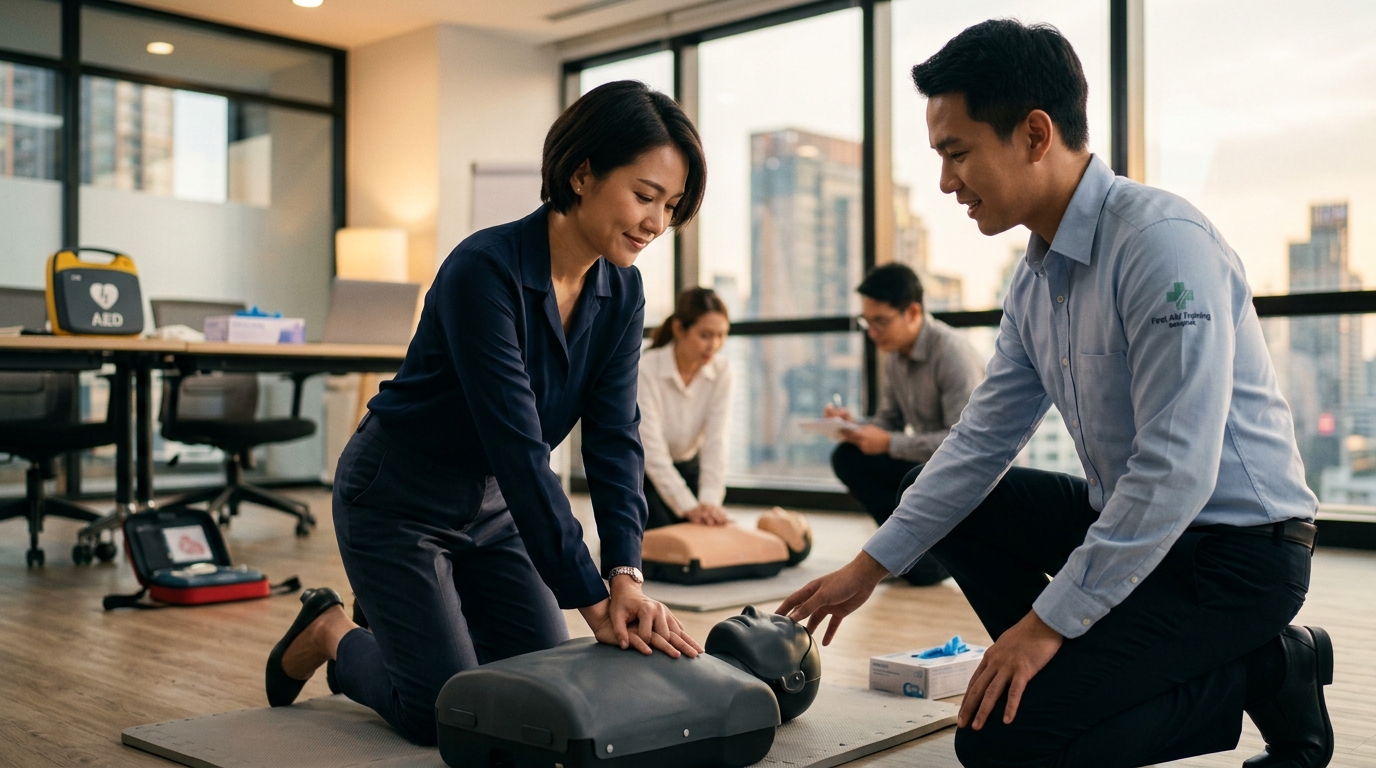
Workplace safety is no longer just about physical hazards. In modern corporate environments, medical emergencies can occur anywhere, from the boardroom to the break room. Immediate intervention by trained colleagues is the single most critical factor in survival rates for cardiac arrest victims. According to recent health data, survival rates for out-of-hospital cardiac arrest can double or triple when bystanders perform CPR immediately. This guide outlines the precise operational steps to integrate high-quality CPR and First Aid training into your corporate infrastructure, ensuring your team is prepared to save lives. (About Us First Aid)
Step 1: Assess Organizational Needs and Compliance
Before booking any sessions, you must conduct a thorough risk assessment of your workplace. Corporate environments vary significantly. A high-rise office in Bangkok faces different challenges than a manufacturing plant or a tech startup with remote workers. Identify the number of employees who require certification and the specific roles that need advanced training, such as safety officers or floor wardens.
Regulatory compliance is also a primary driver. In many jurisdictions, including Thailand, workplace safety regulations mandate that a certain percentage of staff hold valid First Aid and CPR certifications. Failure to meet these legal obligations can result in significant fines and liability issues during insurance audits. Review your local labor laws and corporate insurance policies to determine the minimum baseline for your organization.
Step 2: Select an Internationally Recognized Training Provider
Not all training providers offer equal value. You must select a partner that adheres to the latest international guidelines. The standard for CPR and First Aid changes regularly to reflect new medical evidence. For instance, the American Heart Association and the European Resuscitation Council update their guidelines periodically to optimize chest compression depth and rate.
When evaluating providers, look for accreditation from recognized bodies. First Aid Training Bangkok is the only EFR Center to be internationally recognized and awarded by EFR/PADI Asia Pacific for its outstanding contribution to First Aid Training. This accreditation ensures that the instructors are not just certified, but are elite trainers with deep expertise in emergency response. Verify that the provider uses the latest international standards for their curriculum.
Additionally, check the provider's track record. A provider with over 10 years in the field and more than 17,000 happy clients demonstrates reliability and scalability. Look for testimonials from other corporate clients to gauge their professionalism and ability to handle large groups.
Step 3: Determine Training Logistics and Delivery Methods
Corporate training requires flexibility. Traditional classroom settings may not be feasible for all employees. You have three primary options for delivery:
- On-Site Training: The provider comes to your office. This minimizes downtime and allows for customized scenarios based on your actual workspace. First Aid Training Bangkok offers on-site CPR certifications and First Aid courses training at your location in and around Bangkok, and anywhere in Thailand.
- Blended Learning: This combines online eLearning theory with in-person hands-on training. Employees complete the knowledge portion remotely, saving valuable office hours for the practical skills assessment.
- Off-Site Workshops: Employees attend a centralized location. This is useful for team-building exercises but may incur additional travel costs and time away from work.
Consider the size of your groups. Large corporations may need multiple sessions to avoid disrupting operations. Ensure the provider can scale their instructor team to meet your volume requirements without compromising the quality of instruction.
Step 4: Customize Curriculum for Corporate Risks
A generic First Aid course may not address the specific risks present in your corporate environment. Work with your training provider to tailor the content. For example, if your office has many elderly employees or those with pre-existing conditions, emphasize cardiac care and stroke recognition.
Key components of a robust corporate curriculum include:
- CPR and AED Use: Cardiopulmonary Resuscitation (CPR) is a lifesaving technique that is of critical importance for certain people who suffer a cardiac arrest. An Automated External Defibrillator (AED) is a portable device that delivers a therapeutic dose of electrical energy to the heart to restore normal rhythm. Training must cover both manual and AED-assisted resuscitation.
- Choking and Airway Management: Airway obstruction is a common emergency in dining areas and meetings. Training should cover the Heimlich maneuver and basic airway clearance techniques.
- First Aid for Common Injuries: This includes treatment for burns, fractures, bleeding, and shock. First Aid is the immediate assistance given to any person suffering from either a minor or serious illness or injury, with the care provided being dependent upon the severity of the condition.
- Emergency Action Plans: Teach employees how to activate the emergency response system and guide paramedics to the scene.
For specialized roles, consider advanced courses such as Tactical Combat Casualty Care (TCCC) or Stop the Bleed, which focus on severe trauma management.
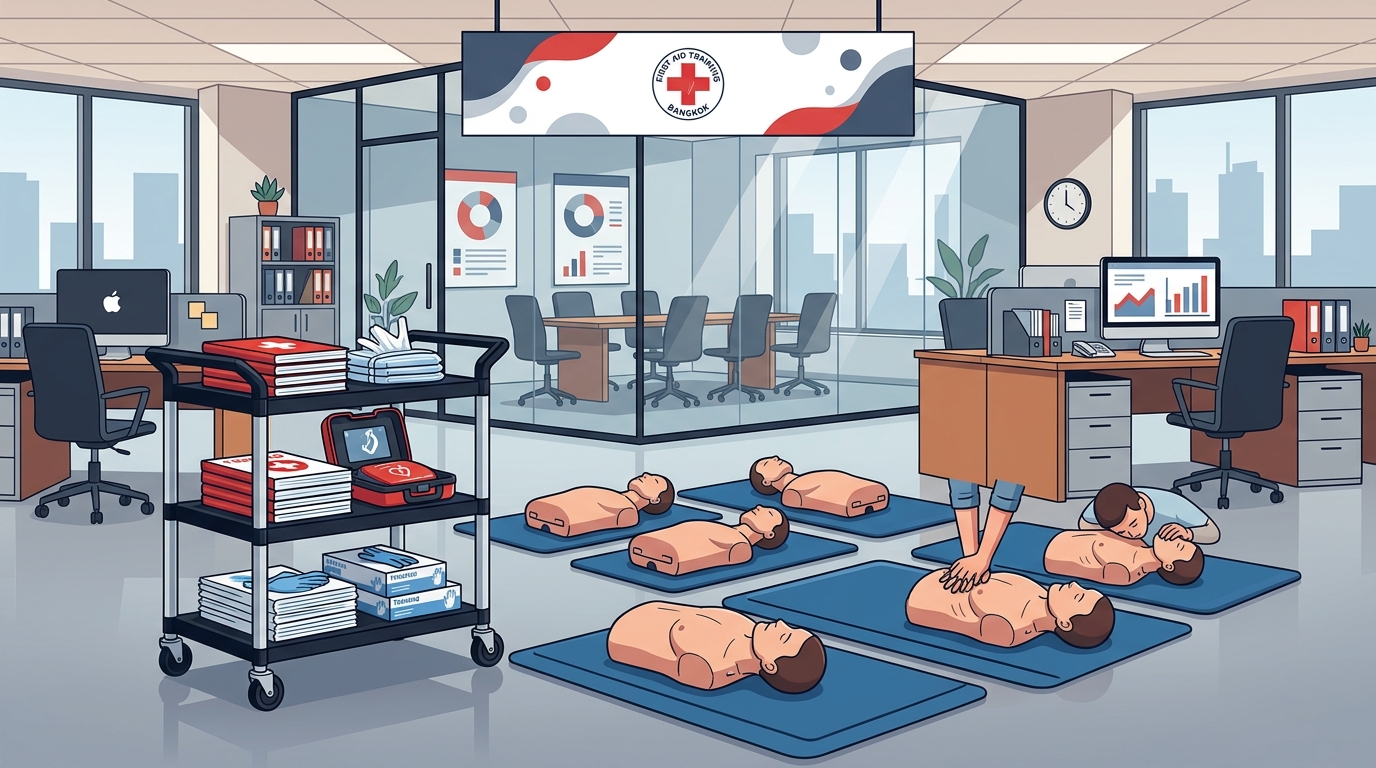
Step 5: Execute Training and Manage Certification
Once the provider is selected and the logistics are set, schedule the training sessions. Communicate the importance of the training to all employees to ensure high attendance and engagement. Employees learn best when they are relaxed and having fun, so choose a provider that fosters a low-stress, interactive learning environment.
During the training, ensure that every participant gets hands-on practice with CPR manikins and AED trainers. Theory alone is insufficient for building muscle memory. The provider should conduct skills assessments to verify competency before issuing certificates.
Manage the certification records meticulously. Keep a digital log of all employees who have completed training, their certification dates, and expiration dates. This data is crucial for compliance audits and for scheduling refresher courses. First Aid Training Bangkok provides internationally recognized certificates that are valid for a specific period, typically two years.
Step 6: Maintain Compliance and Refresh Skills
CPR skills degrade rapidly. Studies show that without regular practice, the ability to perform CPR correctly diminishes significantly within three to six months. Therefore, a one-time training event is not enough. You must establish a recurring training schedule.
Set reminders for certification renewals. Offer refresher courses that are shorter and more focused than the initial training. This keeps the knowledge fresh and ensures that new employees are onboarded with the same safety standards. Regular training reinforces confidence and reduces hesitation in real-life emergencies.
Consider integrating safety drills into your regular corporate activities. This helps normalize emergency response and ensures that the entire organization is aligned in its approach to safety.
Comparison of Corporate Training Options
| Training Type | Cost Estimate (THB) | Best For | Pros | Cons |
|---|---|---|---|---|
| Corporate On-Site Training | Starting from 8,900฿ | Large offices, minimal downtime | Convenient, customized scenarios | Requires space setup |
| Individual Certification | Starting from 2,900฿ | Small teams, flexible scheduling | Cost-effective, quick | Less team cohesion |
| Advanced Safety Courses | Contact for Price | Safety officers, specialized roles | High-level skills, TCCC | Higher cost, longer duration |
Key Takeaways
- First Aid Training Bangkok has been the #1 CPR Certification provider in Thailand since 2009, offering over 10 years of experience.
- The provider is the only EFR Center internationally recognized and awarded by EFR/PADI Asia Pacific.
- Corporate training packages start from 8,900฿, providing cost-effective solutions for businesses.
- On-site training is available throughout Thailand, minimizing disruption to office operations.
- Certifications are internationally recognized, ensuring global validity for multinational corporations.
- Regular refresher training is essential to maintain skill retention and compliance.
- Having a Medical Advisory Board ensures that training content is always up-to-date with the latest medical guidelines.
Frequently Asked Questions
How long does corporate CPR training take?
Standard corporate CPR and First Aid courses typically last one day, approximately 6 to 8 hours. Advanced courses or blended learning options may vary in duration depending on the curriculum depth.
Is the CPR certification valid internationally?
Yes, the certificates issued by First Aid Training Bangkok are internationally recognized. They follow the latest international guidelines, making them valid for global corporate compliance.
Can you provide training for remote employees?
Yes, First Aid Training Bangkok offers "LIVE" Online CPR Certification Training. This combines online eLearning theory with in-person hands-on training for those who cannot attend on-site sessions.
What is the cost of CPR training for corporations?
Corporate training packages start from 8,900฿. The exact cost depends on the number of participants, the type of course, and whether it is conducted on-site or off-site.
Do you offer training for specific medical emergencies?
Yes, in addition to standard CPR and First Aid, we offer specialized courses such as Tactical Combat Casualty Care (TCCC), Stop the Bleed, and Emergency Oxygen Provider training.
How often should employees undergo CPR refresher training?
It is recommended that employees undergo refresher training every two years, or annually for those in critical safety roles, to ensure skills remain sharp and compliant with current standards.
What qualifications do your instructors have?
Our instructors are elite professionals, including EFR Instructor Trainers, Medical Doctors, and Critical Care Nurses. They possess extensive experience in emergency response and education.
Ready to Empower Your Team?
Don't wait for an emergency to reveal the gaps in your safety preparedness. Take the first step toward a safer workplace by contacting First Aid Training Bangkok today. Our team is ready to design a custom training program that fits your corporate needs and budget. Contact Us NOW to schedule your consultation and start saving lives.